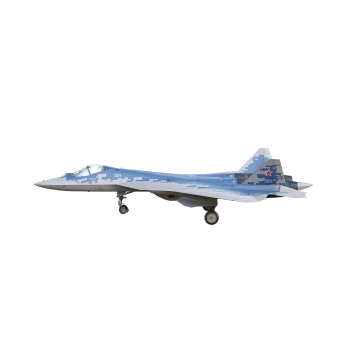
Russian Su-57 "Felon" multi-role fighter (blue)

Russian Su-57 "Felon" multi-role fighter (blue)
It is a fifth-generation multi-role fighter developed by the Russian Sukhoi Design Bureau and is designed to compete with American F-22 and F-35. It is famous for its stealth characteristics, supersonic cruise capability and advanced avionics system. It adopts subsonic flying wing layout with stealth design, including special wave absorbing coating, flying wing layout shape design, rectangular engine nozzle shape, and maximum use of composite material technology. It has flexible take-off and landing capabilities and can take off from a variety of different types of airports. Its design and capabilities make it an important part of Russia's air power, representing the cutting edge of modern fighter technology.
Russian Su-47 "Berkut" fighter (dark green)

Russian Su-47 "Berkut" fighter (dark green)

It is a supersonic fighter developed by the Russian Sukhoi Design Bureau and first flew in September 1997. The design goal is to be a next-generation fighter with ultra-maneuverability and stealth capabilities, designed to replace Soviet-era fighters and meet the needs of modern air combat. The most notable feature is its forward-swept wing design, which is similar to the American X-29 test machine and can provide a higher lift-to-drag ratio and better maneuverability. Significant progress has been made in technology, but due to the inability to meet the specific needs of the Russian military, it finally failed to enter mass production. But it marks Russia's innovation and development in the field of fighter design.
Russia Su-33 "Flanker-D" fighter

Russia Su-33 "Flanker-D" fighter

It is a single-seat two-fire all-weather carrier-based multi-function fighter developed by the Russian Sukhoi Design Bureau based on Su-27. Designed for the Russian Navy to meet the operational needs of aircraft carriers, it has enhanced landing gear and structure, as well as folding wings to adapt to carrier-based operations. It first flew in May 1985 and entered service in 1994. The design includes increased duckwings and increased wing area for improved lift and maneuverability. The folding design of its wings and tail reduces the area occupied on the aircraft carrier deck and increases the aircraft capacity on the deck. It is an important part of the Russian naval aviation,
Russian Su-30 fighter

Russian Su-30 fighter

It is a two-seater, two-engine multi-purpose fighter developed by the Russian Sukhoi Design Bureau based on the Su-27 fighter. The NATO code name is "Flanker-C". It first flew on December 31, 1989 and was designed to meet the needs of modern air combat with outstanding air-to-air and air-to-ground combat capabilities. The design emphasized maneuverability and versatility, adopted a swept-wing layout, and was equipped with two AL-31F turbofan engines. Since its service, it has been procured by several countries and has become an important part of the modern air force. Its design and performance make it excellent and adaptable in a variety of combat tasks.
Russian Su-47 "Berkut" fighter

Russian Su-47 "Berkut" fighter

It is a supersonic fighter developed by the Russian Sukhoi Design Bureau and first flew in September 1997. The design goal is to be a next-generation fighter with ultra-maneuverability and stealth capabilities, designed to replace Soviet-era fighters and meet the needs of modern air combat. The most notable feature is its forward-swept wing design, which is similar to the American X-29 test machine and can provide a higher lift-to-drag ratio and better maneuverability. Significant progress has been made in technology, but due to the inability to meet the specific needs of the Russian military, it finally failed to enter mass production. But it marks Russia's innovation and development in the field of fighter design.
Russian Su-57 "Felon" fighter (gray)

Russian Su-57 "Felon" fighter (gray)

It is the fifth-generation twin-firing stealth multi-purpose fighter developed by the Russian Sukhoi Design Bureau. It is Russia's first military aircraft using stealth technology. Designed to perform air superiority and attack missions, its development began in 2002, with its first flight on 29 January 2010. Designed to have supersonic cruise capability, long battle radius, low radar cross-sectional area, super maneuverability and short take-off and landing (STOL) characteristics, while maintaining a large ground attack capability. The design includes a fusion wing-body fuselage, full-motion horizontal and vertical stabilization surfaces, with thrust vector and adjustable leading edge vortex controller to improve high angle-of-attack behavior and allow rapid stall recovery
Russia Su-57 "Felon" fighter

Russia Su-57 "Felon" fighter

It is the fifth-generation twin-firing stealth multi-purpose fighter developed by the Russian Sukhoi Design Bureau. It is Russia's first military aircraft using stealth technology. Designed to perform air superiority and attack missions, its development began in 2002, with its first flight on 29 January 2010. Designed to have supersonic cruise capability, long battle radius, low radar cross-sectional area, super maneuverability and short take-off and landing (STOL) characteristics, while maintaining a large ground attack capability. The design includes a fusion wing-body fuselage, full-motion horizontal and vertical stabilization surfaces, with thrust vector and adjustable leading edge vortex controller to improve high angle-of-attack behavior and allow rapid stall recovery
Russian MiG-35 multi-role fighter (gray)

Russian MiG-35 multi-role fighter (gray)

It is a 4-generation multi-purpose fighter developed by the Russian MiG Aircraft Group. Based on MiG-29M/M2 and MiG-29K/KUB technologies, it has improved flight performance, advanced avionics equipment and diversified precision guided weapons. The aerodynamic layout adopts a design that relaxes the longitudinal static stability, and is equipped with a three-channel four-redundant digital line flight control system and a larger thrust engine to improve maneuverability. Increased internal and external fuel loads and aerial refueling capabilities significantly increase range. Reduced radar and infrared signatures, equipped with the latest self-defense kits and redundant aircraft systems, improve survivability
Russia MiG-29SE Fulcrum multi-role fighter

Russia MiG-29SE Fulcrum multi-role fighter

It is a multi-role fighter developed by the Russian MiKoyan Design Bureau and is an improved model of the MiG-29 series. It is designed to adapt to the changing battlefield environment, with enhanced avionics and weapon systems. Equipped with N01 radar and active jamming station, it is capable of carrying external underwing fuel tanks and up to six RW-AE active radar guided missiles, capable of attacking two targets simultaneously. The design emphasizes multi-role combat capabilities, including air-to-air and air-to-ground missions. The flight performance is excellent, with a maximum flight speed of Mach 2.35 and a service ceiling of 18,000 meters.
Russia MiG-21SMT "Fishbed-K" fighter

Russia MiG-21SMT "Fishbed-K" fighter

It is an improved model of MiG-21 series fighter, designed by Russia's MiGaoyan Design Bureau. It is known for its upgraded aerodynamic performance, increased fuel capacity and advanced electronic countermeasures equipment. Equipped with a more powerful engine that provides fast acceleration and extremely high speeds. The fuel capacity is also increased, which significantly improves the range, but this also leads to an increase in weight. The design requires pilots to relearn how to fly and engage enemy aircraft because they quickly lose speed when maneuvering, but can quickly regain speed with powerful engines if safely disengaged and flying straight.
Russian MiG-31K fighter model

Russian MiG-31K fighter model

It is an improved model developed by Russia's MiGaoyan Design Bureau on the basis of MiG-31, specially designed to carry hypersonic missiles. It inherits the high-speed and high-altitude flight characteristics of the MiG-31, while adding new avionics and weapon systems. Capable of carrying the Kh-47M2 "dagger" air-launched hypersonic missile, this missile claims to have a range of 2000 kilometers and a speed of Mach 10, and can break through the US missile defense system. This capability enables it to perform not only traditional interception missions, but also strategic strike missions. It is a key long-range interception and strategic strike platform in the Russian Air Force.
Russian MiG-35 fighter

Russian MiG-35 fighter

NATO code name: "Fulcrum-F" is a four-and-a-half-generation multi-purpose fighter developed by Russia's Mikoyan Design Bureau on the basis of MiG -29M/M2 and MiG -29K/KUB technologies (according to the US-Russian fighter generation standard). It made its public debut in 2007 and entered service with the Russian Air Force in 2019. The design goal is to improve the handling performance, expand the use and enhance the combat effect. Its maximum take-off weight is 30% higher than that of the MiG -29M2, so it is classified as a medium-weight fighter. The model is being introduced to the international market.
Russian MiG1.42MFI multi-role front-line fighter

Russian MiG1.42MFI multi-role front-line fighter

It is a technology demonstrator developed by Russia in the early 1990 s to demonstrate the technology of the next generation of fighter jets. The design has stealth characteristics, adopts variable geometry air inlet and advanced avionics system, including NIP-NO14 phase array controlled pulse Doppler radar and rear-view self-defense radar. The shape was designed with invisibility in mind, although Western observers were skeptical. It was not put into production due to economic problems and the high cost of the project. Nevertheless, the technical demonstration provided valuable experience for the Russian aviation industry and influenced subsequent fighter design.
Russia Su-30SM multi-function fighter

Russia Su-30SM multi-function fighter

It is a multi-functional fighter developed by the Russian Sukhoi Design Bureau based on Su-30MKI, specially designed for the Russian Air Force. This two-seat, two-engine fighter is known for its excellent maneuverability and advanced avionics equipment, and can perform a variety of tasks such as air superiority, ground attack and electronic warfare. The fuselage is made of titanium alloy and high-strength aluminum alloy, which has high maneuverability and is realized by thrust vector control. Equipped with N011M passive phased array radar, the maximum detection range of up to 400km, can track multiple targets at the same time. The weapon side is capable of carrying a weapon payload of up to 8 tons.
Russia Su-35 multi-role heavy fighter

Russia Su-35 multi-role heavy fighter

Also known as "Flanker-E" or "SuperFlanker", it is a single-seat dual-engine multi-purpose heavy fighter that has been deeply improved by the Russian Sukhoi Design Bureau on the basis of Su-27. It belongs to the fourth-generation and a half-fighter. It is known for its excellent maneuverability and advanced avionics, with long-range, multi-purpose, air optimization and strike characteristics. Two 117 engines provide vectoring thrust and are highly maneuverable, capable of launching guided missiles, unguided bombs and other weapons systems, while striking multiple aerial targets. The maximum carrying capacity of 8 tons, can carry all kinds of Russian precision guided weapons.
Russian Su-30MK multi-role fighter

Russian Su-30MK multi-role fighter

Also known as the Flanker-H is a two-seater, two-launch multi-role fighter developed by the Russian Sukhoi Design Bureau and is part of the Su-27 fighter family. It is designed to meet a variety of combat missions, including air superiority, ground attack, electronic warfare and maritime strikes. Features include its advanced avionics, strong weapon payload capabilities, and superior maneuverability. Two AL-31F turbofan engines are equipped with thrust vectoring capability, which allows the Su-30 MK to perform complex maneuvers. Maximum speed up to Mach 1.9 with a service ceiling of 17,300 meters
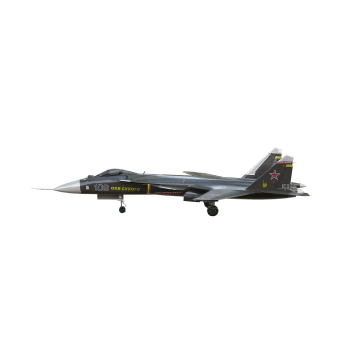
Russian Su-34 "Fullback" fighter/bomber (black)

Russian Su-34 "Fullback" fighter/bomber (black)

It is a twin-engine, two-seat, all-weather supersonic medium fighter/bomber developed by the Russian Sukhoi Design Bureau. is a derivative of the Su-27 "Flanker", originally known as Su-27IB, intended to replace the Su-24 "Fencer". The design retains the basic layout of the Su-27, including the fuselage structure, engines, wings, empennage and most of the on-board equipment, while using Su-30 canards to improve maneuverability. Characterized by its side-by-side two-seater cockpit and "platypus"-shaped nose, this design provides better ergonomics and collaborative efficiency.
Russian Su-34 "Fullback" fighter/bomber (blue camouflage)

Russian Su-34 "Fullback" fighter/bomber (blue camouflage)

It is a twin-engine, two-seat, all-weather supersonic medium fighter/bomber developed by the Russian Sukhoi Design Bureau. is a derivative of the Su-27 "Flanker", originally known as Su-27IB, intended to replace the Su-24 "Fencer". The design retains the basic layout of the Su-27, including the fuselage structure, engines, wings, empennage and most of the on-board equipment, while using Su-30 canards to improve maneuverability. Characterized by its side-by-side two-seater cockpit and "platypus"-shaped nose, this design provides better ergonomics and collaborative efficiency.
Russian Su-34 "Fullback" fighter/bomber (blue camouflage)

Russian Su-34 "Fullback" fighter/bomber (blue camouflage)

It is a twin-engine, two-seat, all-weather supersonic medium fighter/bomber developed by the Russian Sukhoi Design Bureau. is a derivative of the Su-27 "Flanker", originally known as Su-27IB, intended to replace the Su-24 "Fencer". The design retains the basic layout of the Su-27, including the fuselage structure, engines, wings, empennage and most of the on-board equipment, while using Su-30 canards to improve maneuverability. Characterized by its side-by-side two-seater cockpit and "platypus"-shaped nose, this design provides better ergonomics and collaborative efficiency.
Russian Su-57 fighter jet

Russian Su-57 fighter jet

The Su-57 fighter jet is a single seat twin engine stealth multi-functional heavy fighter jet of the Russian Air Force, and is the fifth generation fighter jet of Russia (referred to as the fourth generation fighter jet by Western countries). The Su-57 fighter jet has a maximum takeoff weight of 35000 kilograms, a supersonic cruising speed of up to 1450 kilometers per hour, a top speed of 2140-2600 kilometers per hour, a combat radius of 1200 kilometers, a combat payload of up to 6 tons, and four built-in weapon compartments. It can achieve a good combination of flight performance and stealth performance, and has the ability to engage in aerial combat and ground attack. It has the characteristics of good stealth performance, short takeoff and landing distance, super maneuverability, and supersonic cruising.